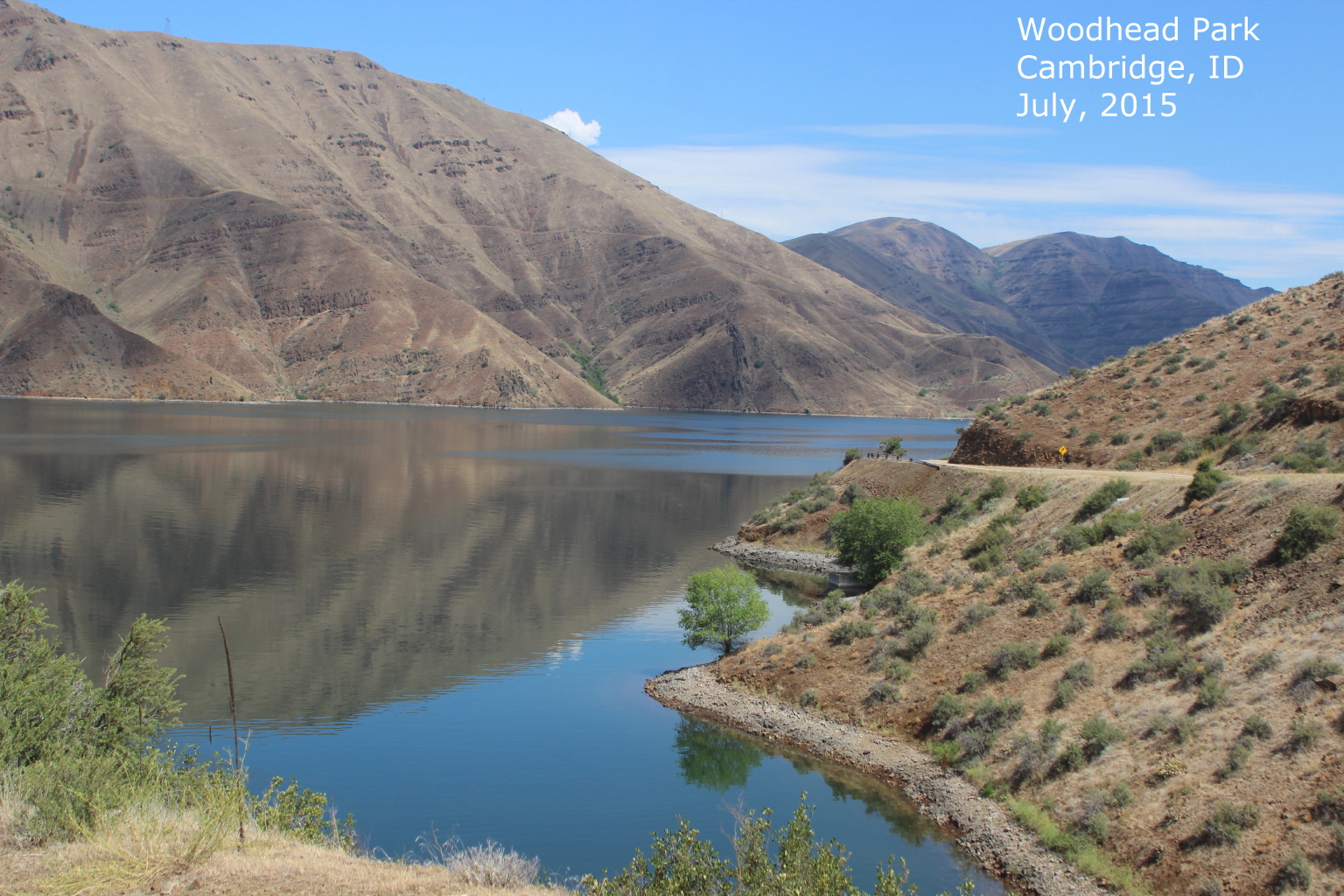
We headed out to Woodhead Park from our
overnight in Weiser to look for a spot for breakfast –
parking
being critical when we have the RV behind us. The Country Coffee
Cabin in the little town of Midvale, Idaho was just what we were
looking for and more than we expected. It wasn't particularly busy –
after all, it was nearly 8:30 and folks around here get started early
– but our waitress was friendly and quick with the coffee, so we
were happy. We got our meal and were pleasantly surprised. Rich had
ordered an omelet and I had the cowboy breakfast. Rich's omelet was
beautifully prepared and tasty, and my breakfast was enough to feed
three people. It had sounded reasonable on paper – two eggs, hash
browns, bacon, and a biscuit with sausage gravy, but the reality was
giant-sized. Believe it or not, it was as good as it was big. No, I
didn't eat it all, but Rich helped me pare it down by eating half of
the biscuits and gravy. Yum!
There was an older gentleman sitting at
the table next to us and after listening to him talk, it sounded as
though he was a local, so once his table mate had left, I explained
we were staying in Hells Canyon for a week and asked if there was
anything he thought we should be sure to see. He had been in the area
most of his life and
he told us about Kleinschmidt Road, which,
handily starts right in the canyon. We put it on our “to do”
list. On our way out the door, I spotted a tray of cinnamon rolls and
having had a yen for a good one we anted up the five bucks and headed
on our way. I had planned on using this 6” square pastry for two
nights of desserts, but of course we had a bite just to try –
marvelous. (It did make it for two nights of desserts, believe it or
not.)
We wound around the mountainous
landscape, past cattle ranches, rocky outcroppings, and
along miles
of forested countryside. The landscape changed abruptly just before
entering Hells Canyon area – barren desert mountains loomed above
the Snake River which, as its name implies, twisted and turned
through the surprisingly beautiful scenery. We entered the park,
owned and maintained by the Idaho Power Company. Idaho Power has four
lush, modern campgrounds (including wi-fi) throughout the canyon and
three dams. We were in the southernmost campground and the nearest to
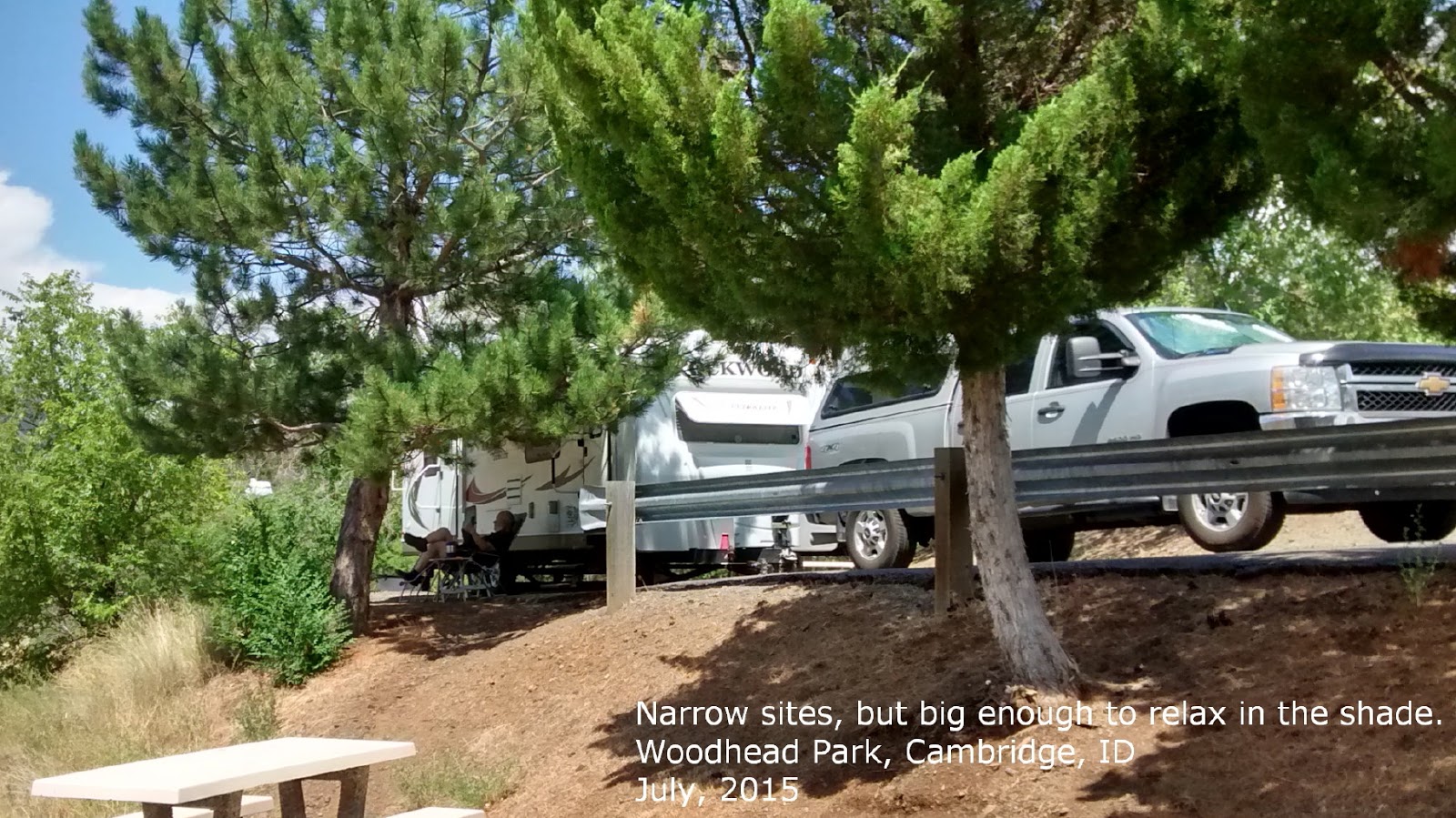
a town of any size. The camp sites were fairly small and close
together, but the park is geared
toward hikers and boaters, so most
folks aren't in camp other than to sleep.
Hells Canyon (historically without the
“'s” but sometimes with it), is not a recognized geographic
place, but according to “Hells Canyon” by R.G. Bailey, it starts
90 miles south of Lewiston, Idaho and extends 40 miles south to a
point near Oxbow, Oregon, but that is not a unanimous opinion. It
will, however, give you an idea of just where it is. During the late
1800's, it was called Box Canyon or Snake River Canyon. I found a
book about life on a sheep ranch in the
area during the 1930's, “Home
Below Hell's Canyon” by Grace Jordan which I found very
interesting. I love to read books about an area we're going to visit
– it seems to enhance the whole experience.
Hells Canyon is considered the deepest
canyon on the North American continent. The deepest part of the
canyon is seven miles downriver from the Hells Canyon Dam, one of the
narrowest points of the canyon. Here the canyon plunges 7,913 feet
from the 9,393 summit of He Devil Mountain to the mouth of Granite
Creek, 1,480
feet above sea level.
Construction of the dam was quite an
ordeal in this inhospitable region of towering granite peaks and, for
all intents and purposes, no level ground. Once a bridge was built in
1962 across the Snake River at Oxbow, Oregon, the two-year long task
of building the 23 mile long access road was cut along the base of
the cliffs on the Idaho side. Once the road was built, a 40 x 40 foot
tunnel was driven 1,800 feet through solid rock to divert the water
during the construction process. Helicopters were used to move tools
and
equipment into place and to erect transmission towers. Once it
was time to pour concrete, the operation proceeded day and night, six
days a week, until 700,000 cubic yards of concrete had been poured.
Despite the cramped working space, the concrete for Hells Canyon Dam
was built to the full 330 foot height, 1,000 foot length in only
sixteen months. It produces 1,166,900 KW, twice a much as the rest of
the Idaho Power hydroelectric system.
The drive along the river, past the
dams, to the north end of the road where we found the visitor center
for the area was mind-boggling. The high
mountains looming over the
winding river made us feel insignificant but the scenery was
breathtaking. After we stopped at the visitor center, we turned
around and retraced our drive to the turn that took us up the side of
a mountain on Kleinschmidt Road on a narrow dirt road that scared the
daylights out of me! The view was amazing, although when I look at
some of our pictures and remember a car passing on that little road,
I do get queasy again. On the way back to camp we stopped in Council,
Idaho for lunch.
Prospectors in the 1860's and 70's used
the trail
through the area to reach the boom towns of Florence and
Warren. They saw large Indian trade gatherings which the prospectors
thought were council meetings, hence the town name. The railroad came
to town in 1901 and that boosted the town's prosperity. Council was
the closest railroad point to the newly-discovered Thunder Mountain
gold strike and thousands of fortune seekers passed through. The
story that caught our attention happened in 1904 – a piano was
dragged out of the Tank and someone played “There's a Hot Time in
the Old Town Tonight” while two buildings burned! I guess it always
helps to have a sense of humor, but isn't it a bit like Nero fiddling
while Rome burned?
Time seemed to fly by and after a few
walks through the campground and a grocery run, we were on our way to
Washington.
 |
| Law enforcement around here has some righteous boats! |
 |
| Council, Idaho |
 |
| Council, Idaho |
 |
| Old steam tractor, Council, Idaho |
 |
| Old steam tractor, Council, Idaho |
 |
| Old steam tractor, Council, Idaho |
 |
| I love reading the notices in restaurants, grocery stores, etc. in these little towns - I never know what I'll find! Council, Idaho |
 |
| I love reading the notices in restaurants, grocery stores, etc. in these little towns - I never know what I'll find! Council, Idaho |