Rich and I both looked forward to this - I was born on a farm in Illinois and Rich worked on a neighbor's farm in New York when he was a kid.
Sadly, there is not much information on
line about either the history of the show or the current day
statistics, but through chatting with some of the many volunteers, I
found out a bit. Some years ago, an old farmer in the Buckley area
showed a neighbor a old engine in his barn. Then the neighbor showed
the old farmer an engine he had, and as the years passed, more
farmers got together. In 1967, the Buckley Old Engine Show was born.
In the 47 years it has been existence, it has grown to an amazing
size, with tens of thousands of people attending the four-day show
and 1,174 tractors on display. I can't begin to guess how much
acreage the show covers, but just recently the club purchased an
additional 60 acres. Currently, there are more than 30 buildings on
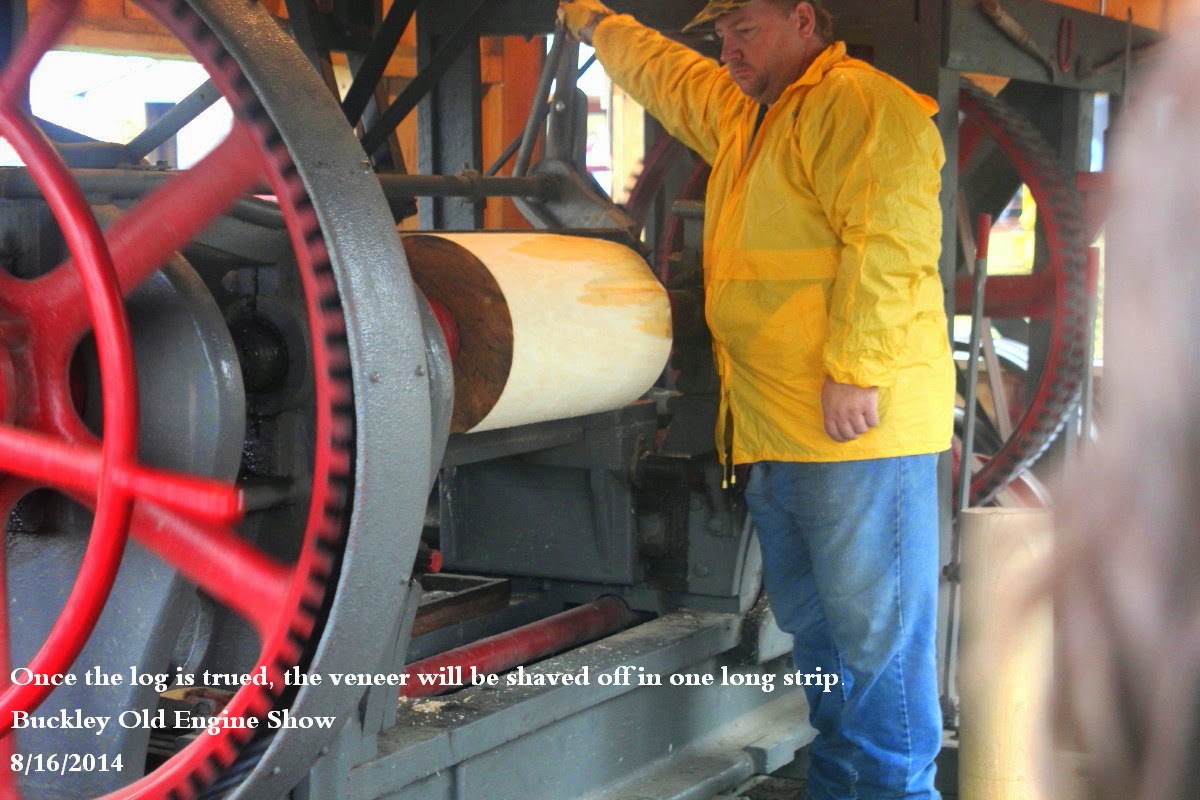
property including a steam powered sawmill circa 1800's, and a planer
and shingle mill, where the wood for all the buildings on property
was sawn, planed, and turned into shingles or veneer, or perhaps wall
studs and the like.
Some of the volunteers arrived a week
before the show began to assist in set-up, and ready to use and many
were farmers performing demonstrations of machines that had been used
by their parents and grandparents. Many of the young men I talked
with held jobs in town and helped their dads on weekends and harvest
times. All I spoke with voiced sorrow that they could no longer
support their family on their family farm.
The show is held annually the third
weekend of August and in addition to the engines on display, there
are scheduled events all four days. With events ranging from Farm
Chore Demos to a working veneer mill and lots of other interesting
things, surely everyone can find hours of entertainment.
In addition to the demonstrations,
throughout the four day event, there is a steam-powered tractor
parade that weaves through the streets. 2014 boasted a new addition
to the offerings: the Spirit of Traverse City train, a quarter-scale
train purchased by the club, whose members then completely restored
the engine, all the cars, and caboose and was available for free
rides on a track that circled the grounds.
There is a campground for visitors, one
for vendors, one for a huge flea market, and another for exhibitors.
The exhibitors are private parties who have old items to display.
They are lined up in rows with their antiques out front and their RV
or tent behind. Many of these old items were running and the folks
are full of great stories about how they got involved in the show or
collecting. One fellow we spoke with who had a couple of “hit or
miss” engines told us he had gone to a nursing home to visit his
grandma when he was nine. He was given a dime to buy a pepsi and on
his way to make his purchase when an old lady called out and asked
him to come in and talk with her. He was sorely tempted to continue
on his way, but his upbringing won out and he went into the room. She
told him her son had stopped going to see her and so had her
grandchildren, and she was 96 years old and lonesome. He heard his
Pepsi calling, but sat and talked with her. Soon, she was telling
stories of her youth. Her stories fascinated this nine year old and
on Monday morning during show-and-tell at school, he raised his hand
for the first time that year. The old woman's stories poured from him
for 45 minutes, mesmerizing his classmates and teachers. He went on
to collect old farm implements and on occasion found items that had
been used years ago by his family.
Main Street
A walk down Main Street boasts a
blacksmith shop, a harness maker, and general store in addition to
the tonsorial parlor where a barber was offering shaves and haircuts.
We ducked into the Old Time Necessities Shop during a downpour and
found all sorts of crafts being demonstrated. There was a grandpa and
his granddaughter demonstrating how to make jump ropes, folks caning
chairs, a woman crocheting rag rugs, an example of the “penny”
rug, man playing a hammered dulcimer (my absolute favorite
instrument), and two women making hooked rugs. I had never seen a
hooked rug before, but it is a tedious undertaking. First the design
is drawn onto linen fabric, then woolen fabric is felted, cut, and
dyed to the required colors. Only then does the actual hooking begin.
It is called a hooked rug because a crochet hook is used to pull the
yarn through the backing. The green rug with flowers took the woman
four months, and the one she's working on in the photo was begun a
year ago. The rugs were beautiful, but I fear I don't have the
patience to try this!
The penny rug was made during the mid
to late 1800's, and got it's name because the large penny coin of the
era was used for the pattern of circles of fabric, which were then
sewn together.
I talkd to a woman working on
needlepoint canvas and the large picture she was completing had been
started in 1981. If I'm going to do traditional needlepoint, I need a
key fob-sized project :)
The hammered dulcimer player was quite
interesting – he had played trombone and piano before retiring,
when he took up the dulcimer. He explaied how the instrument was
strung, and each section of the instrument was one octave in a
different key from the previous section. The notes of the scale
alternate from the left to the right side of the two bridges. It
seems complex but everyone I'e talked to insists it is an easy
instrument to learn. I'd love to take a lesson one day to see if I
have the knack for it. I feel about the hammered dulcimer the same
way I felt about the French horn the first time I heard it. I went on
to learn the French horn and enjoyed playing it for years.
The print shop used a 1955 Heidelberg
press, which was used for all the printing associated with the event:
parking passes, maps, mailings, signs, programs and such. Printing
for this event begins in early summer.
Across the street from these stores was
the train station where one could catch a ride around the area on a
coal-powered steam engine. We saw steam and old internal combustion
engine powered cars, trucks, and tractors of all kinds – some with
wheels that stood taller than Rich's six foot three inch height.
Beyond the tractors are more buildings
– the saw mill, veneer mill, oil well pumping building, planer and
shingle mill, gas engine building, steam building, foundry, and
machinery buildings. Farther along are the food and music pavillions,
where we got some wonderful BBQ chicken and rhubarb pie with ice
cream for dessert, and had music to eat by! Throughout all this are
the typical food vendors you'd find at fairs, rodeos, and races
Veneer Mill
The building at the show is about half
the size of a regular commercial veneer building during this time
period. There would be two rooms, each outfitted with lathes and
other tools needed. Sections of logs would be loaded in one of the
rooms, closed off, and steamed for a day while the logs that had been
steamed the previous day would be debarked, loaded onto the lathe
using a chain hoist and tongs, and turned. It took a number of turns
to get the log perfectly round, but once it was, a thin sheet of wood
peeled off in long lengths and this was the veneer. It would then be
processed and used various pieces of furniture.
Threshing and Straw Baling
We were a bit late to arrive for the
demonstration of the threshing and straw baling but the guys were
just finishing up a bale and then were happy to talk with us and show
us a few more things.
The newer of the two balers, although
more automated, still left lots of hard work for those manning it. It
was run by a belt from a nearby tractor, but the straw would have
been forked into the hopper, by hand then a plunger would have shoved
the straw into the rectangular bale space – kind of like stuffing
sausage into casing. The older of the two was all man-power.
Depending upon how tightly the straw was pressed into the cavity, the
hay bale could weigh from 75 to 150 pounds.
At high noon, the steam whistle jubilee
began. It was a collection of about 15 different-sized steam-powered
whistles, each of which had a rope that operated the lever. When the
rope was pulled, the lever opened the tube so the steam poured out
and made the whistle sound. There were high pitched whistles, deep
booming ships whistles, and many in between. Each noon they would
choose 15 kids to hold the 15 ropes and on their turn, would play
their whistle. It made quite a show.
As you can tell, we were enthralled
with the experience and hope to be in the area again during the show.