Thursday, August 18, 2016

Cottonwood Point, Marion, Kansas; October 5 – 12, 2015


We took a drive into Wichita to do some sightseeing, but between impossible traffic and worse parking we had about given up when we found the Mid-America All Indian Center. What an amazing place. Its a large place – we never even made it into the gift shop, where they had some amazing art, baskets, and pottery. Part of the interior is a large open area and is used as a venue for tribal gatherings as well as displays of ceremonial dress, photographs, flags of all the different tribes, and other information. Outdoors were paths leading around the gardens with Native American artwork tucked away here and there to be enjoyed in the quiet, peaceful setting . All this led to a large display the center of which was a magnificent sculpture the “Keeper of the Plains” by Blackbear Bosin. “Blackbear Bosin, a Kiowa-Comanche Indian, born in 1921, at Anadarko, OK, continues to be recognized among the greatest of Indian Artists. His design of the sculpture, the "Keeper of the Plains" has become a symble for the City of Wichita and the focal point of the Sedgewick County Seal. He was also a founding member of the Board of Trustees of the Mid-America All-Indian Center.

The Keeper of the Plains is a 43 foot tall, five ton Cor-Ten steel Sculpture. The sculpture, commissioned by the city and private organizations to mark the United States Bicentennial, was erected in 1974. It has since become one of Wichita's most recognized and beloved symbols.” From a sign at the Mid-America All-Indian Center

We had planned on visiting the Eisenhower Library in Abilene but I wasn't feeling well so we decided to try it next time we're in the area. We did the usual laundry, cleaned, baked bread, and got groceries, but nothing exciting or particularly interesting although we did see some spectacular sunsets during our stay. Somehow, neither of us are particularly interested in getting back to Florida except to see our kids and grands.

Next stop is Hawthorne Bluff, Oolagah, Oklahoma.


Riverside Park City Campground, Ellis, Kansas; September 28 – October 5, 2015

As we left Methodist Cove, we saw two tractor trailers, each with a huge, white cylinder – we think the vertical part of a wind turbine. We had passed them on the way into the campground on Friday, but because of the oversize load, they were parking for the weekend, but on Monday, a couple of miles down the road we saw them underway again again. There seemed to be two main crops in the area we were driving through: oil fields with storage tanks and pump jacks and acres and acres of a brick red-topped plant that looked a bit like corn. As we passed through the countryside, we noticed a cowboy on his horse overlooking the countryside. It was another of the popular hilltop silhouettes we've seen in the west – everything from dinosaurs to moose, bears and even a jack-a-lope!

Ellis is a small town (2,100 people) with several blocks of stores. Most on Main Street were occupied and it was a pretty little place with some beautiful old buildings. A few miles down the road is the city of Hays (21,000 people) and has a much larger selection of stores and restaurants. Ft. Hays University and a branch of Kansas State University are also located there. Our new “home” at Riverside Park is definitely a small city RV Park. I use the term “RV park very loosely” – although it's kept clean, the restrooms are old and dark, and mainly it's a place to park an RV with hookups. The river the campground is next to is very low – the drought is several years old here and you can certainly tell. About half the occupants a construction or oil field workers who were quiet and friendly. That being said, it was a satisfactory if not particularly attractive place to spend the week.

We visited Augustine Obour, a young man who worked with Rich before we retired, while going to UF for his Ph.D. in soil science. Augustine was working at the University of Kansas in Hayes where we visited his office and were treated to a tour of his lab and the experimental plots where they working on hybridizing a drought resistant sorghum, which was the red-topped corn-like plant we saw. I found learning about his work fascinating, perhaps because my Dad was a farmer in Illinois and I've been a gardener most of my adult life. I was interested to hear they are finding that by boring holes for the seed more soil moisture is retained than if plowed. Even when they mulched the plants after plowing, the plants didn't do as well as those growing from the bored holes. I remember reading about Native Americans and early settlers using sharp sticks to make holes in the soil in which to drop large seeds such as corn and beans. In fact, I've planted seeds that way a time or two myself in my garden. I love it when we find that the old way is the better way! (Augustine – if I got this wrong, please let me know and I'll correct it.) After our tour, Augustine and his grad student took us to lunch at a wonderful B-B-Q spot, then that evening we were invited to Augustine's home for dinner with his family. His wife, Mary, had made a delicious goat soup, Augustine barbequed ribs and there were yummy sides and we brought dessert. It was so good to see them, catch up on their life, and share our experiences on the road. We had to leave sooner than planned, but we hope to see them next time we're in the area.


Now, we're off to Cottonwood Point Campground, a US Army Corps of Engineers park near Marion, Kansas.


Methodist Cove USACOE CG, Alma, NE; September 21 – 27, 2015


Alma is a lovely little town of 1,300 and a median income of 40K and an average home price of 49K. Most of the homes we saw were nicely kept up and the town seemed busy with most of the old buildings filled with stores open for business. What was once probably a hotel had been turned into shops on the lobby level and apartments above. Other businesses served multiple purposes as well: you could pick up your dry cleaning in the variety store and you could rent DVD's in the hardware store. The grocery store had a tent-like duck blind for sale in the front of the store. We found dried beef in the deli case – first time ever for me (I've always seen it in glass jars) and I can't wait to fix some dried beef gravy over biscuits.

The campground was mostly empty and that may be because it was not as well-run as most other corps parks. The dump station had a bar welded across the drain so it was impossible to hook up the hose; the fresh water fill station was so close to the dump station if one unit was dumping another couldn't fill the fresh water tank; the restrooms needed updating and the water in the shower never got warmer than lukewarm. The sites are large and well-spaced although the little pea-sized gravel in the site drive made it difficult to get the RV level.

A wedding was held one afternoon in the middle of our loop with loudspeakers that would have done an arena proud. Apparently, according to the folks setting up the wedding and reception, we were supposed to have been told about it and offered a chance to move. We weren't and the reception continued, music blaring until nearly midnight. I finally lost patience and had the host call the sheriff (we had no cell service there). It was quiet soon thereafter.

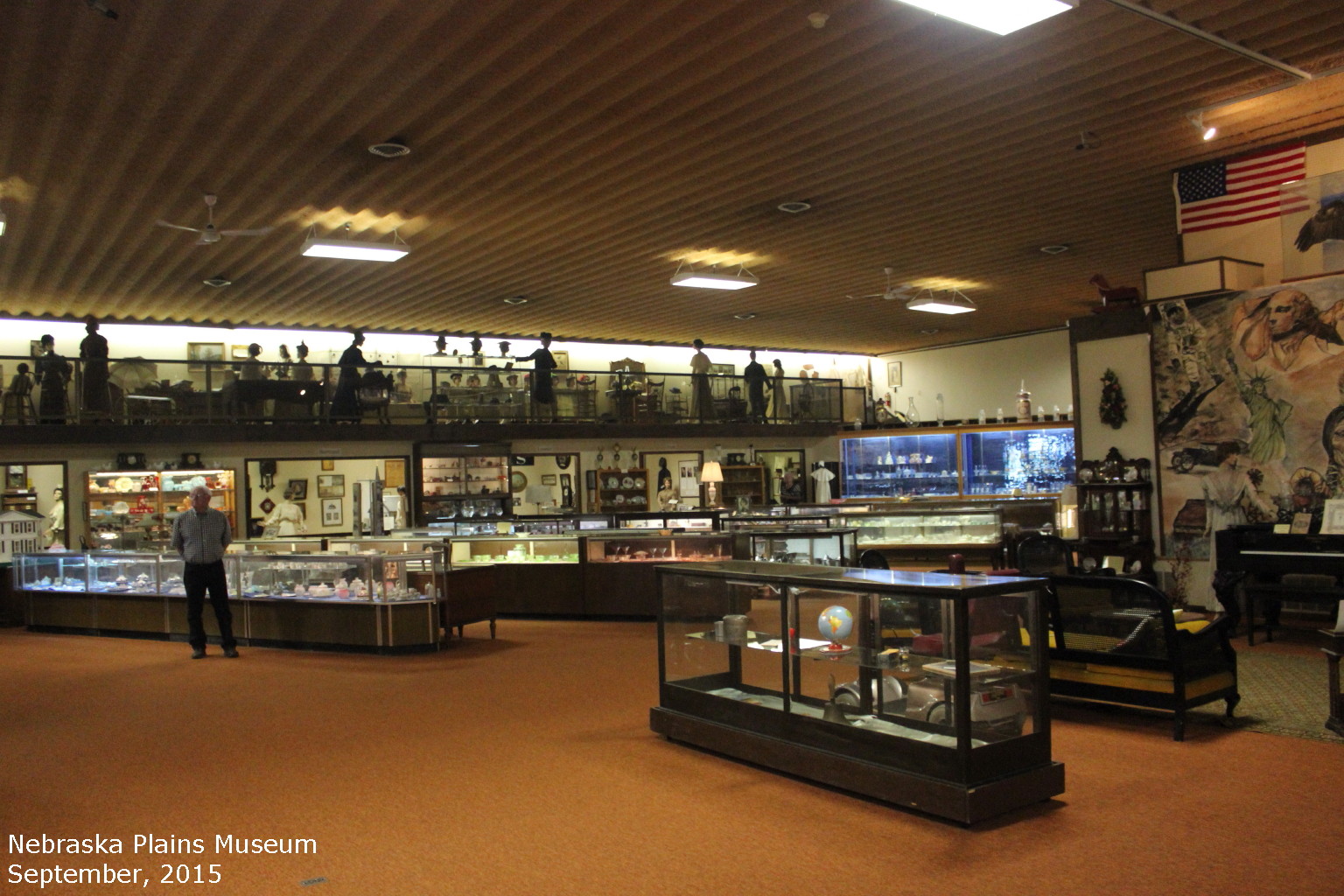
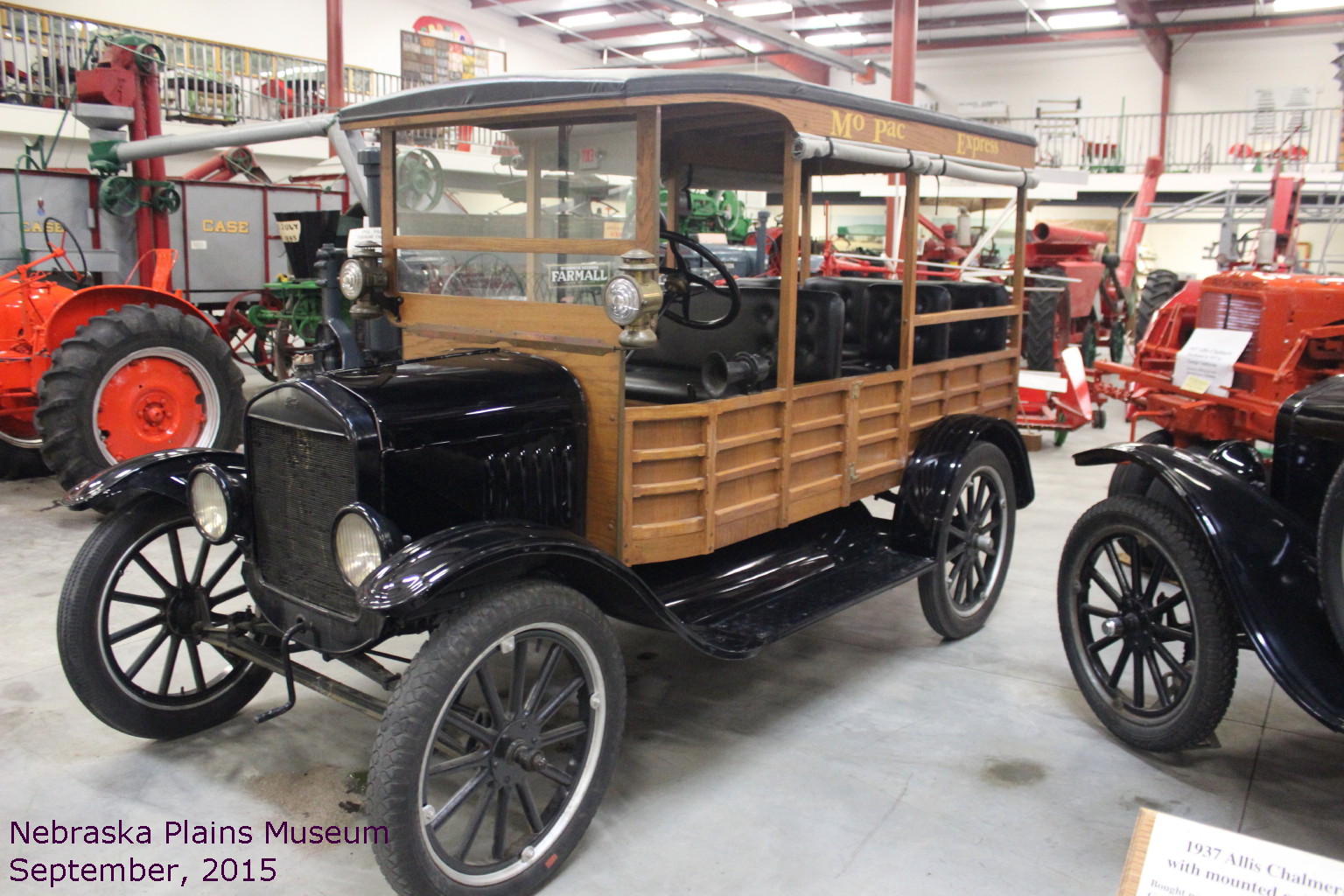
While there wasn't much to see around Alma, just down the road near Atlanta, Nebraska was the highlight of our say here: the Nebraska Plains Museum. Most if not all of the work was done by volunteers and the exhibits were donated by locals – one woman's china, another's glassware, an uncle's woodworking tools. There were probably 20 old manual typewriters, all different. A large area was set up as a town square with 15' x 15' “businesses” with representative goods and furnishings in each. Outside boasted a church, a home circa 1890's and a POW guard tower to represent the portion of the museum dedicated to the armed forces and the German prisoner of war camp that was located a few miles down the road and was the base camp for the 18 POW camps in the area.

The Thomas F. Naegele collection of paintings “In the Eye of the Storm” is also on display in the museum. These paintings capture the daily life in the prison camp through the eyes of Naegele, who was a soldier and acted as interpreter at the camp. Mr. Naegele went on to have a very successful career as a graphic artist in NYC and generously donated his artwork to the museum.

The entire population of the county in 1940 was fewer than 9,000 persons and most of the men between 18 and 35 had volunteered or been drafted into military service which meant that about 50% of the adult male population was out of the area. Many of the folks left in the area had jobs in the military production facilities thus depleting the workforce for local jobs. Much of the economy of the area was agricultural but many “town” jobs were short of skilled labor as well.

German soldiers, few of whom were sympathetic to Nazi Germany goals, were happy to train and work both in camp and local jobs for pay. A total of nearly 100,000 prisoners passed through Camp Atlanta's gates and were housed there or sent to one of the other 18 POW camps in the area.
Within six months of the end of the war in Europe, all 18 of the other camps had been closed. Less than a month later the entire Camp Atlanta was deactivated and the POW's were sent on their long journey home. Often, they were detained in other European countries and Russia as workers, some didn't reach their final destinations for two and three years. Still others never made it. More than one former prisoner came back to the US after being returned to his home country. One brought his whole family and practiced medicine in Scottsdale, AZ into the late 1900's. Another returned with his family and farmed nearby. Some former prisoners wrote to friends they had made of guards and locals that there was no food to be had in Germany – no gardens left nor livestock. The news prompted many boxes of food to be shipped to former prisoners.

For the most part, it appears that the majority of prisoners were happy, but all the stories weren't happy ones. About 8% of the POW's in the camps were sympathizers with the Nazi goal – mostly SS agents and the like. Sadly, these men were said to be responsible for 72 coerced “suicides.” Perhaps more sobering was that at the end of the war, Stalin had insisted that all Russians in German uniforms be sent back to Russia first. There, immediately upon disembarking from the ships they were herded into a dockside warehouse and shot as traitors. [“The Last Secret” by Nicholas Bethell, 1974]
We spent several hours there and could easily have gone back the next day. While the museum wasn't glossy and sleek like new museums, we were blown away with the number and depth of the displays and information. If you're ever in the area, it's a place you shouldn't miss.

Next stop: Riverside Park in Ellis, Kansas.